Saturday, July 16, 2011

Magic at Machu Picchu

Friday, July 8th – At Machu Picchu

Machu Picchu is stuffed to the gills with people. I show my passport to the guard at the entrance and pass through the turnstile. I’m in. I hate to admit that I’m tired and a little grouchy. I’d bought an espresso at the train station and had a cup of coffee on the train, and yet I’m still not feeling a buzz. Being in the midst of a crowd is not the way I want to experience this Incan wonder. I want my first glance of the place to enlighten me, but it doesn’t.

 I’d bought an all-inclusive package which includes a two hour tour and I’m bustled around, shuffled between groups, and, about the time I’m going to go explore on my own, finally end up in the proper English speaking tour.
There’s four of us; me, an American man, and a German couple whose male part is a tall blond specimen wearing a bright red shirt and whose elbow ends up in many of my pictures.
Behind me the tall red-shirted German

Our guide is Darwin, a very enthusiastic historian who has worked at Machu Picchu for thirty-one years and has written five books on the Incan culture and Machu Picchu. His smile is infectious. “Dear friends,” he says at the start of each new fact and I feel I am his friend. When he shows us the water that the Incans utilized he tells us that the water came from two springs, only he says it “esprings.” “Two esprings,” he says, “AMAZING!”
The Incan trail goes from Cusco to Machu Picchu and the Incans would travel the fifteen day trip in order to reach this religious site. Darwin tells us that there were about three hundred permanent inhabitants and thirty residences. The ones who lived there were people specially selected to look after the holy site. He tells us that the Incans built Machu Picchu using their own system of terracing. They built the retaining walls from the bottom up in order to avoid rock slides and flooding. They also used stone tools made out of non-magnetic hematite (for one) to cut the gigantic stones into such precise shapes to fit one on top of the other. The site’s construction does nothing to destroy the natural environment around it; the Incans worked in harmony with the earth and the sky. I wonder what went wrong between them and us.

“Dear friends, Machu Picchu is unfinished,” Darwin says. “The Incans abandoned it before finishing. There are three reasons for this. The first reason is that when the Spanish invaders came in the year 1500 they brought small pox with them and millions of the Incans died. The second reason is that in the year 1529 the two Incan prince brothers fought and the country was thrown into a drastic civil war. During the disruption the civil war caused, the Spanish joined forces with one of the brothers and attacked the Incans. After defeating the one side they betrayed the other victorious Incan brother, beheading him in the square of Cusco.”
Darwin gets a twinkle in his eye.
“The Spanish never found Machu Picchu. How do we know this? Dear friends, it’s because here you do not see a Catholic church. Machu Picchu is the only example of an original intact Holy City of the Incans.” All around me stand gigantic stones that the Incans used to trace the path of the stars, to chart the days of the year, to establish their holy days, to worship the Pachamama (the earth), and to worship the water that helped them sustain life. This is a place that allowed them to live and worship between the earth and the heavens. I’m glad that the Spanish did not make it this far.


I follow my guide around a corner and suddenly I see them. My two Colombian friends, Juan Jose and Diego. A smile comes to my face from a wellspring of joy in my soul. My dear friends, I think, well met!


“Amanda!” Diego calls out as he grabs me into an overjoyed embrace. We exchange quick updates and how-de-dos. “I’m on a tour,” I say sadly, but then brighten, “It should be over in about an hour.”
“Okay,” they say pointing, “meet us up at that casita in an hour.”

I agree and hurry after my vanishing group. I’m eager to meet back up with my buddies, but I encourage myself to stay in the moment. And I’m glad I do. We come to a strange stone—the Inti Huatana (the sun dial). “This is the holy rock,” Darwin says, “the holy rock the Incans used to set their holy days. This was not a stone to set the hours or minutes by, but a stone to set the significant days.”
Another group crowds up the Inti Huatana. The guide tells them something and I watch as the people rub their hands together and place their palms over the stone.

“Why are they doing that?” I ask Darwin.
“Some people believe this stone has a special energy,” he explains. “They say that if you rub your hands together and touch the stone--only it’s not allowed to touch the stone anymore, so if you rub your hands together and place them over the stone you might feel the energy.” He looks at us and his tone is slightly skeptical. “If you believe in that kind of energy then you too (dear friend, I interject) may try for yourself to see if you feel anything from the stone of the energy.”

I don’t mind skepticism so I step up to the rock and rub my hands together.


I hover my left palm over the stone. Sharp electric sparks tingle through my fingers, into my hand and travel up to my elbow. It may only be static electricity. I don’t care. No longer do the crowds matter. No longer do I feel tired or grouchy. I felt something there in Machu Picchu and it was magical.


Friday, July 15, 2011

On the Way to Machu Picchu

Friday, July 8th – On the Way to Machu Picchu

My transportation to the taxi that will take me to the train is coming at six AM. I get up early and get ready. I pack some snacks, make sure I have my passport, drink a cup of coffee and eat some toast and sit and wait until the shuttle arrives. The lady packs me in. About eight blocks down the road we stop and a guy who smells a little of alcohol gets in the front seat. I’m thinking he’s been up all night celebrating the 100 Year Anniversary. He has my tickets for the train, for the bus up to Machu Picchu, for me to get into Machu Picchu and all of my return tickets as well. “Do you speak Spanish,” he asks. “Yes,” I reply. So he gives me all the instructions, tucks me into the front seat of a taxi and sends me on my way. “My cell number is on that page if you need anything at all,” he calls as we drive away.
The country is up early
Young girl pulls her uniform jumper up
Over her white shirt
As she yawns
And comes out of the house
To see the day
Horses
Tethered together
Follow the man
Somewhere
To do something
Dogs scavenge through the garbage
Hoping for last night’s remains
Even the dogs under the table get the master’s scraps

We pass through a million little beautiful poor towns with names like Chinchero and Ollantaytambo. The taxi driver likes the left side of the road. The one that is for oncoming traffic. He occasionally gets up the nerve to pass the slower vehicles to the right of us. He returns to the right side of the road when he has no other choice.
I see a woman and a child
Tending a herd of pigs
Whose ending will be just as fatal
As the swine
Who ran into the sea
After being possessed by Legion
 
I don’t take out my camera as we drive. I just write what I see instead.

Six worker stand in the road
Three use brooms
To sweep away the dust
That omnipresent dust
While the others
Fill up potholes
With tar rocks

 A little farther down. A little closer to the train station.

A father
Puts the brush under
The running water
The spigot splashes water against the cold ground
He hands the toothbrush
To the very little girl
Teaching her dental care
Care, caring for her

We reach the town where the train station is. I walk to the entrance and go in. The guard asks me for my ticket and then tells me I can’t go to the station platform until twenty minutes before my departure. I have about forty minutes to kill so I go sit at a café and get a breakfast of bread, juice, and coffee. I’ve drunk more coffee and eaten more bread in the last three days than I have in the last three years. I figure it’s a little better for me than U.S. fare since it’s not overly processed and doesn’t contain high fructose corn syrup. Here’s hoping for health.

In the train I sit next to a girl from Colorado. “You look familiar,” she tells me. We figure it’s because we both have that Coloradan air about us. “Maybe we adapt to the environment we live in,” she says. Speakers feed out panpipe music and I gaze out the windows at the incredibly gorgeous terrain. The sky, the mountains, the air, the company, all reminds me of Colorado. I realize that I still love Colorado and it will probably always feel like home to me.
Panpipes
Mountains
I am here
My heart might still belong in Colorado
That’s a strange way to say it.

I disembark from the train in the town below Machu Picchu. At the front gate there’s a girl with a sign with my name on it. Though my last name is spelled Huate. Or something like that. It’s close enough. I follow her to a small shop where I wait for what seems an eternity for them to get our group on a bus and taken up to the top of the mountain where all of Machu Picchu is. I just want to see it. I don’t want to wait any longer.


A Lunch Date Miracle

Thursday, July 7th – The 100 Year Celebration of Machu Picchu’s Scientific Discovery
The Colombian boys and I rolled back into The Flying Dog at 3:30 AM. So after a scant amount of sleep I decide to make the most of the available light and get up. I take a cup of very strong coffee and my moleskin journal and go sit on the front steps and try to write down as much as I can remember of the past two days. I don’t want to forget.
In that moment I say:


Sitting on the dusty step
Outside The Flying Dog
The sun warming me outside
Café warming me
Waking me
Buzzing tired from only four hours of sleep
But no headache
No malaise
Just the happiness of being

Juan Jose and Diego are heading to Aguas Calientes to stay one night then head on to Machu Picchu. They settle their accounts and put their backpacks on. “Are you going to miss us?” Juan Jose asks me. “Claro (of course),” I reply. “I’ll miss you too,” he tells me. How did we make friends so quickly? I really am going to miss them. We all hug goodbye. “Cuidate (take care), chau (ciao),” we say. They’re still lingering in the hostel lobby and I have a lunch date so I head out.
Several weeks ago I’d met a British traveler named Matt at a party in Lima. He happens to be in Cusco now and we’d arranged to get together for lunch. “Let’s meet at the Statue of the Ninth Inca in the middle of the Plaza de Armas at 1:45,” I suggest.

So around 1:15 I make my way to the Plaza. When I get there I realize what a mistake I’ve made. Today is the 100 Year Anniversary of the scientific founding of Machu Picchu by Hiram Bingham in 1911. The place is packed. PACKED.

I can’t figure out how to get to the statue, they have it blocked off and people are so thick, even with my Lima crowded bus practice there’s no way I can make it through. I skirt the Plaza trying to see if I can see Matt. No use. I walk past the dancers with their black masks. I walk past the dancers with their long noses and gilt dresses. I hear someone call my name. It’s Mei! She’s in the plaza with some of her new friends and happened to see me. We exchange pleasantries and arrange to maybe meet again on Sunday. I have a hope that if she can see me out of the masses  that maybe I’ll find my British friend.
Matt has my number but I don’t have his. I decide to go send him a Facebook message from an internet café around the corner telling him I’ll be standing in front of Gatos Market which is much less crowded. Maybe he’ll get that and we’ll manage to meet.
I wait for forty-five minutes. I’ve gotten to the point where I wonder if I’ll even recognize him if he walks past since I’ve only met him once before. It’s getting late in the afternoon and all I’ve had in the way of nourishment is coffee. So I decide to go get lunch on my own. I head back to Choque Chaca Road to a vegetarian restaurant a few doors down from my hostel. I eat some carrot soup, a salad, veggie lasagna and a fruit compote. Then I check my email on the hostel’s computer. Matt had responded only nine minutes ago saying he’d meet me at Gatos Market.

With a glimmer of hope I run all the way down Choque Chaca, down Hatun Rumiyoc and come to a screeching halt in front of the store. Matt is there! Still waiting. I give him an enthusiastic hug and tell him how glad I am we finally connected nearly two hours past our original meeting time.

He’s practically dying of hunger. I regretfully tell him I ate without him but that the food at the vegetarian restaurant had been great. So we go back there. He gets the dinner fare since the lunch meal is over. While we visit he shows me pictures of his trip to Machu Picchu and we talk of poverty and extortion and life and energy and even dire warnings.     
He tells me that while he was waiting next to Pachacuti (somehow he’d been able to get near the statue) he’d run into an Israeli girl he’d traveled part of his route with in the square and she’d needed a quiet place to sleep since she was feeling unwell, so he’d taken her to his hostel and while he was there he’d checked his email and gotten my message.

I feel there is some kind of magic in this place to make things all work out in the end. We truly are on Peru time, so what’s a couple of hours of waiting?


In Which I Party Like a Bright Young Thing

Wednesday, July 6th – Lunching, climbing, riding, dancing

Carlos is fussing with his bags. He talks in a never-ending low voiced mumble. In this way he invites me to go with him to the Plaza de Armas to watch some of the preparations for the next day’s 100 Year Anniversary Celebration. Just then Juan Carlos’s friend Diego arrives. This trip to Cusco is his first time out of Colombia and he’s thrilled to be in Peru. They invite me to walk around with them. I’m only slightly ashamed to say that I weasel out of Carlos’s invitation and head out into the blue with my Colombians.

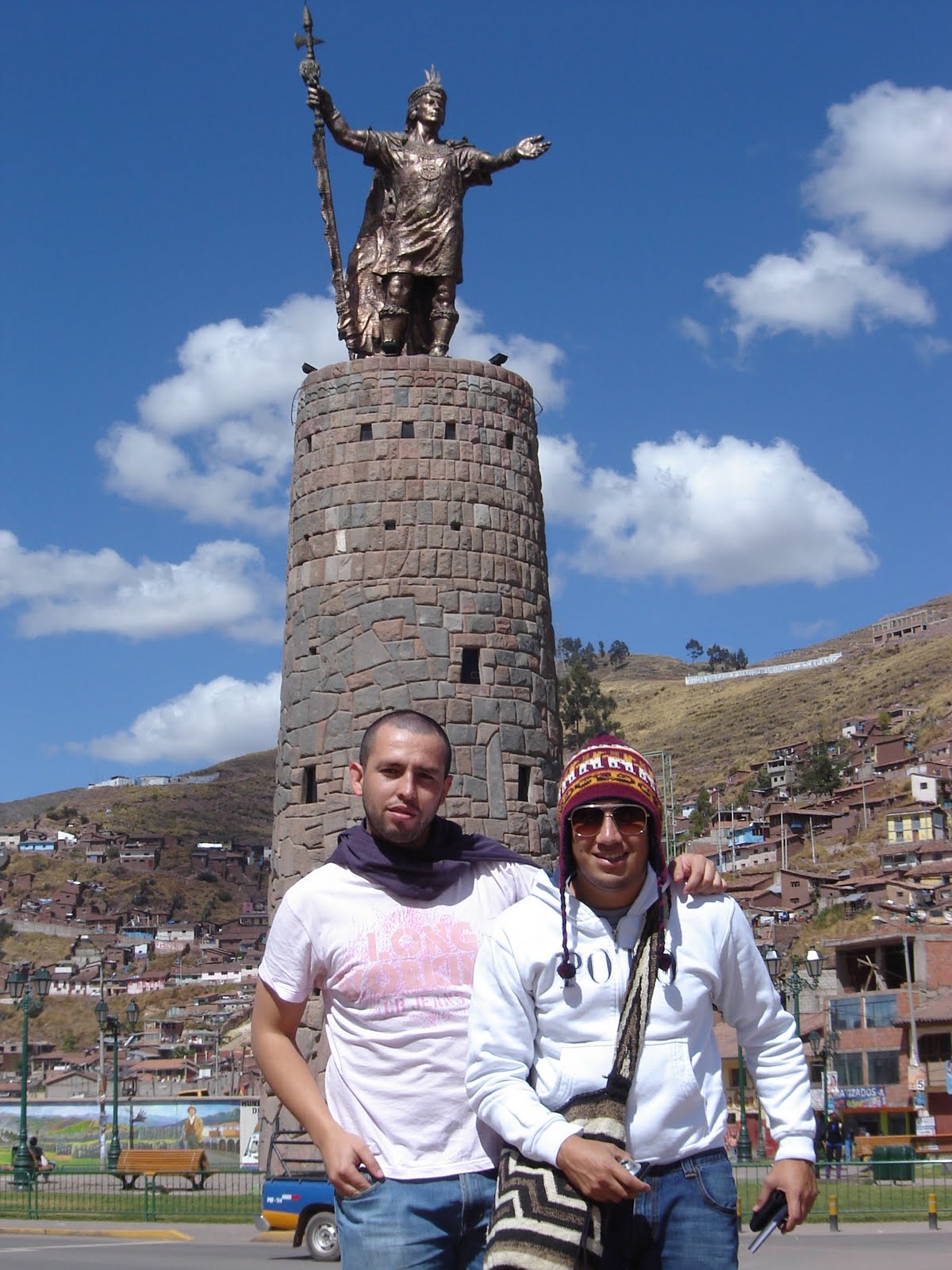
We walk to the Plaza de Armas and take pictures of the churches, of a vendor who tells us “For you a special price,” of the statue of the ninth Inca. We hand our cameras to a willing photographer and climb the steps to sit for a photo. The guard standing at the foot of the steps yells, “One of you must come down. Only two at a time.” We look at each other. Did we exceed some weight limitation? I didn’t think I was fat. “Am I too fat?” Juan Jose and I ask each other at the same time.

We watch a bunch of other tourists pose on the steps for pictures. “You’re a writer,” Juan Jose says to me, “tell us the story of that statue.”
“Once upon a time,” I start. Diego and Juan Jose laugh. And then I start in on a story about the Incans and their king and how the Spanish had to build a fortress in the square to try and deceive the Incans and then how eventually to save his own life Pachacuti turned into gold. Or maybe it’s Juan Jose’s continuation of the saga that tells of Pachacuti’s spectacular form and how he came to life at night and had a queen who was made out of silver. And then Diego takes the next plot thread and weaves it in as we encounter more statues, buildings, and people throughout the morning. I’m sure our history of Peru will become a bestseller one day.

Another man, tall and blond, gets yelled at for going too high up the steps. In the meantime Juan Jose turns to the guard and gets him to tell us some of the real history of the Incans. “She told us,” he tells the guide pointing back at me, “but she lies. She makes up stuff all the time.” Pachacuti stands above us all proud and golden as if he’s waiting to hear more about his past and his people.
We walk on. Through the city, taking pictures, telling stories, laughing.
Juan Jose and Diego
The boys start talking about gossip mongers and scandals. They ask me what the English word for “amarillista” is. Amarillista is a person who lives to write about or read about or live scandals and gossip. I come up blank and tell them I don’t know. “You don’t even know English,” they tease me. “You’re not American. Maybe you could call someone in the States and ask them what the word is.” So we decide I must be Brazilian. (Later, the closest I can come to that word is Scandalmonger. I do a google search right now and feel a little better when the initial page says No Results Found. Sensationalist is probably the closest to what amarillista really means.) Throughout the rest of the day I embrace my Brazilian heritage though I don’t think I know a word of Portuguese.
Before I left Lima I had emailed a lady who submits her stories about Peru to the Peru Writers Group I’ve been attending. She’d agreed it’d be fun to have lunch together and today is the day we’d scheduled to meet. I ask the boys if they want to come along to the San Blas Plaza and have lunch with Rinda, me, and Mei (my friend from the airport if you missed meeting her in a previous blog). They’re amiable to the idea so we take a taxi back to the Plaza de Armas and then head over walking to the Plaza San Blas.
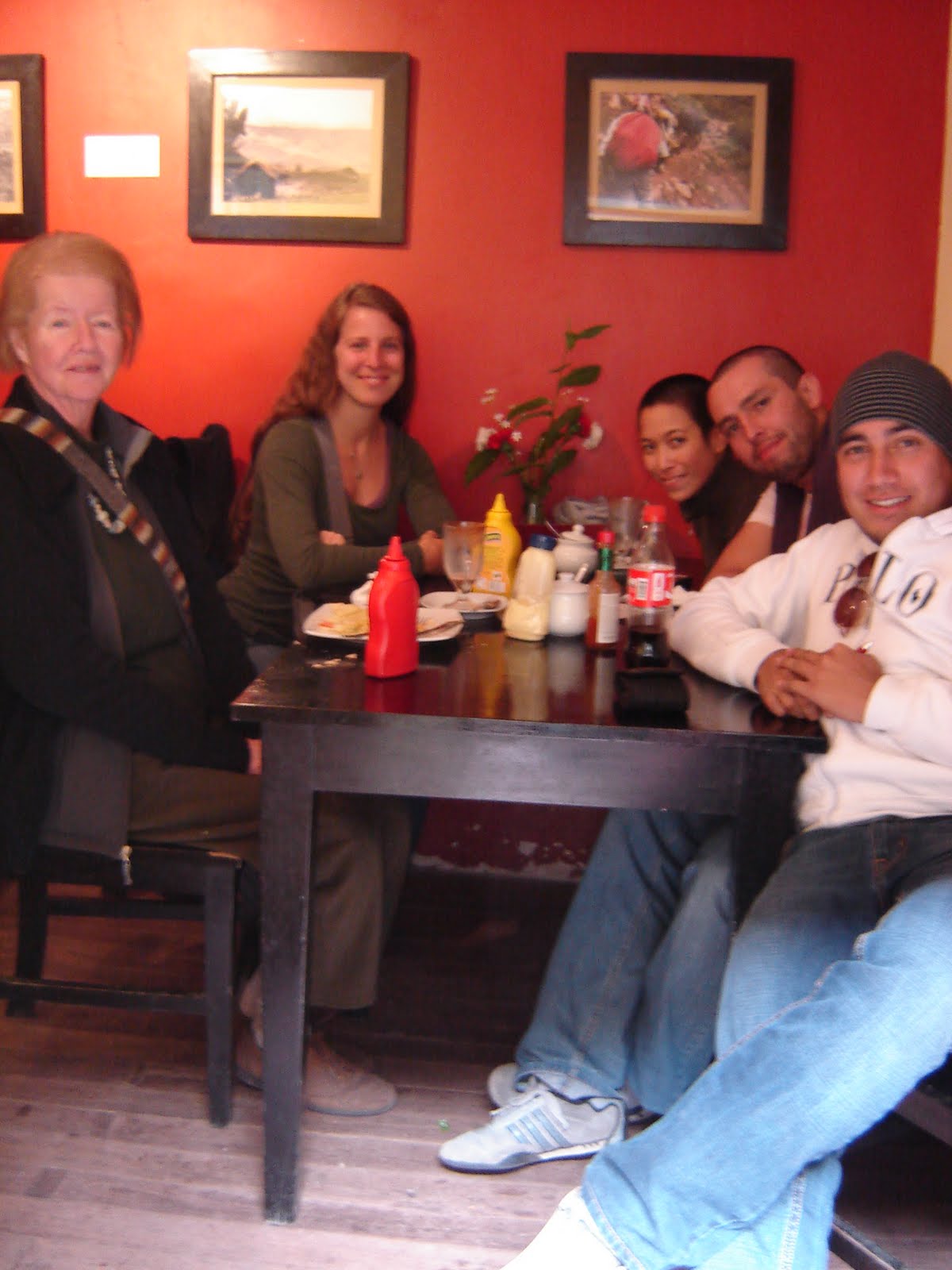
The Meeting Place is a fun little spot, run by an America (I think) and staffed by English speaking students and/or adventurers. We get a table off in the back room and crowd in together. Rinda doesn’t seem fazed that I’ve brought an entourage of friends with me, and I’m relieved. We talk about all our life-paths; where we are, what we’re doing, some of what we’d like for the future. Rinda and I talk about writing and about Reiki healing which she does. Also we eat which is fantastic because we’re all hungry. One of Diego’s favorite lines in English is, “I’m hungry” and he’s been using it frequently in the last hour or so. When we reach the San Blas Plaza I turn to the boys and say, “Let me tell you a story.” They raise their eyebrows and wait for it. “I’m hungry,” I say.
When our lunch is over, Mei and Rinda take a taxi together back to their part of town and me and the boys head off for the ruins of Sacsayhuaman whose pronunciation sounds just like Sexy Woman. We stop off at The Flying Dog to verify the directions and set off on foot. “You’re the guide,” Juan Jose tells me, “don’t lie about the directions like you do about your stories.” Trust me, I think, I have an impeccable sense of direction.

Sacsayhuaman, Quenqo, Pucapucara, and Tambomachay are considered all part of The City Tour which costs 70 soles and can be embarked upon on foot. We get inside the gate of Sacsayhuaman and sit down to see if we want to pay to see it all or not. While we’re contemplating, a man comes over (for you a special price) and tells us that he gives specially priced horseback rides to people who speak Spanish. It’s one of those brother to brother moments, I’m sure. At least it’s a good sales pitch. We decide to buy a trail ride for 35 soles apiece. It’s supposed to include all four ruins, horses and a guide. We follow the salesman to the stables and mount up.
I'm blinking a lot in these pics
Our guide is a 14 or 15 year old boy named Rudy. He clutches the tail of my horse, Principe, and jogs behind us the whole way. Sunset isn’t too terribly far off and I’m not really sure how quickly we’ll go. After trotting along for a while we reach the Temple of the Moon. We dismount. Rudy watches the horses while we walk the ruins. At the top we’re resting for a moment when a group of Americans or Canadians comes up and sits on a rock tablet on the ground. A guide suddenly appears out of nowhere and tells the tourists to get off the rock because it’s a special ceremonial table. He’s not very kind with them and I get the impression immediately that he’s not keen on English speaking folks. Good thing I’m Brazilian.
Of course Juan Jose strikes up a conversation with him and through his agreeable charm wins the guide over from his churlishness. He then takes us on a tour of the rock-top.
He shows us the rock carvings the Incans had made and tells us that the condor represented the path to the next life and reincarnation, the puma represented the strength of this life, and the serpent represented death and the underworld. He shows us the severed heads of the carvings where the Spanish had defaced the Incans’ worship site. Then he leads us down into the taped off entrance of the Temple of the Moon. I’m overwhelmed. This is really the chance of a lifetime to go inside this sacred place and hear the stories, touch the stones, feel the air as it comes through the opening where the moon used to illuminate the whole cavern when the Incans came down to worship the moon, and be in this moment. If I’d come alone I wouldn’t have been favored with a tour. If I’d come with any other than these two friendly Colombians I doubt I’d have had this opportunity. The boys feel a sense of awe as well.
We trace our hands over the black serpent on the wall which the Spanish had been unable to decapitate because the rock was so strong. “For the Incans,” Alain the guide says, “the color black represented purity.” He tells us that the Incans placed a reflective plate on the flat table surface that caught the light of the moon and lit up the cave. He said they’d found llama bones buried all around the floor, that here the Incans had not sacrificed humans but the poor (my own addition) sacrificial llama. Juan Jose tells me that I’m to be the sacrificial llama. Oh joy.

When we come out once again into the daylight and go back to our horses, the boys take a few moments to play futbol with some of the other tourists and guides.
I think their team wins. They huff a little in the altitude and then we mount up again. Rudy tells us that the other sites are too dangerous to go to by horseback and at this hour and he heads us home. The horses are anxious to be back in the stable and they fight for the first spot in line, nipping at each other’s flanks, and being generally disagreeable with their ears plastered to their necks. I’m grateful that I’ve had some riding experience and make my horse stay at the back of the line. I have a laugh at myself when I think of how in America this ride would never have been made without some kind of liability waiver. Litigiousness is so engrained, but not here in Peru.

Juan Jose asks Rudy why we aren’t going to the other ruins as promised. A small scale scene occurs when we get back to the stable with the lady who helps lead our horses off. She tells Juan Jose to wait a minute and then she comes back to hear his complaint. He wants to speak to the salesman and straighten out the difference between what was promised and what was delivered. With us in tow the lady leads us down the mountain back toward the entrance to Sacsayhuaman. She’s dressed in the traditional colorful garb of Cusco and it amuses me when she reaches under her wrap to pull out a cell phone. The salesman doesn’t answer and after a bit more conversation, the boys decide there is nothing we can do and we walk on.
We stop for a moment at the White Christ and look down over the darkening world at Cusco. It’s beautiful. It’s also very cold. Before we freeze to death we find our path through the darkness down the mountain, down the hill, down the steps back to town.

Back at The Flying Dog the girl who helps run the place makes us Pisco Sours and we all trudge upstairs to watch the futbol game. This is the Copa America. It’s a big deal. This game is Colombia vs. Argentina. Juan Jose and Diego are rooting for Colombia of course. There’s another guy from Colombia there too, so it gets a little loud. Diego can’t sit for any of the game. He paces behind the couch and sometimes bites his fist. They all yell at near goals. Many of the other backpackers and travelers crowd the room and there is much cheering and booing as the game goes on.
I wander downstairs and talk with the Brazilian girls who are making dinner. When I remark on how good it smells they invited me to join them. I’m hungry again so I take them up on the offer and we talk English, Spanish, and Portuguese and eat vegetarian spaghetti.

After the game (It’s a tie) Juan Jose, Diego, and I head back out to the Plaza de Armas in search of food, music, drinks and dancing. We go to Mama Africa. I never knew I liked to dance until that moment. I’m partying like some bright young thing and I laugh at myself for this. I laugh again, internally, at the older guy who gives me his card and wants to dance with me. “Where are you from? Are you here alone?” I tell him the United States and No and move away. With drinks inside they’re all shameless and brave.
The place is packed out with people from all over the world
I dance too close
With some dude who’s a little too free with his hands
I look at the emergency exit sign that is translated into English as “Escape”
So I make mine and get away
I dance with Diego and Juan Jose
The music changes
They talk to some pretty girls and I dance with a tall guy
He leans in, asks my name and how old I am
Tells me his name is Javier and offers me a sip of his drink
I shout my name and age at him and shake a finger against the liquor
When the song ends I go sit next to Juan Jose
Next to Diego
I put my head on J.J’s shoulder
“Don’t fall asleep here,” he says. A few beats go by. The music rumbling through our shoes
“Estas feliz? (Are you happy?)” he asks me
“Si,” I reply, because I am
Out dancing in Cusco like I know how
Letting the music – feeling the music
In my blood


Wednesday, July 13, 2011

Hare Krishna and Sapa Inca

Tuesday July 5th Cusco - Afternoon and Evening

There is supposed to be a car waiting to take me from the airport to the hostel, but there isn’t. So I turn to one of the million drivers who swarm the entrance and say, “Taxi? Taxi? Señorita, taxi?” and talk him down from 30 soles to 25 which still seems like a lot to me. But I remind myself that I would have paid 16 soles for the hostel’s transport and I’d saved at least twenty soles by taking the bus to the airport that morning. I also remember that 25 soles is really only about 9 dollars and then it doesn’t hurt as much. I’m cheap, what can I say. Or perhaps, I should say I’m thrifty. I’d better watch my language in this place. These boys get all kinds of ideas.

The sky is brilliantly blue. The sun burns hot and something stronger than joy fills me up full. I try to see everything, breath the place in, memorize it all while the cabbie drives. It’s like love at first sight. Me and Cusco. The beauty, the mountains, the lack of humidity, the elevated air, it reminds me of home—of Colorado.
The cabbie drops me off at The Flying Dog Hostal and I get marked in on the sign-in sheet. Right away I book a trip to Machu Picchu. I’ve arrived just in time for the 100 Year Anniversary of Hiram Bingham’s scientific discovery of Machu Picchu and Thursday the 7th’s trips there are by invitation only and I don’t want to miss out on a chance to go on another day by not booking in time. I get it squared away and then Wilson shows me up to my room.
I’m sharing a dorm room. It has two single beds and a bunk bed. Wilson tells me that one of the beds is already taken by an Australian named Pete but I can have the choice of any of the others, so I snag the bottom bunk bed.

I throw my stuff on the bed and head downstairs. I’d read that it’s advisable to take it easy on arriving in Cusco because the elevation is 11,000 feet. I’m not a total altitude newbie, but I have been at sea level for the past two months and don’t want to get sick. The hostel has coca leaves to chew on and mate de coca (tea) to drink. The coca is supposed to help ward off the mal effects of altitude sickness. I ask the girl who’s working in the kitchen about the proper way to use the leaves. She tells me to chew them and then hold them in my cheek for an hour or so without swallowing them. Like chewing tobacco, I think. Not that I have personal experience with that of course. I stick some leaves in my mouth and walk out the door.

I’m on Choque Chaca street heading downhill toward a cross road that’ll take me to the Plaza de Armas. Above me, an Incan flag flies from a balcony showing all the colors of the rainbow. A strange cat like creature with chalked pink eyes gives me not a thought as I pass. Shops line the street. I gaze through windows. I stop in at one that sells art of the Nasca hieroglyphics. I get to talking to the lady who is tending the store. She tells me that I just missed the worst and coldest weather they’d had in ten years. Rain like you wouldn’t believe and “un viento helado (a freezing wind)” she says pulling her calf-length coat more closely around her. I admire the artwork, remind myself I don’t want to acquire more possessions, finish up our conversation and go out into the sun.  

The streets are packed with vendors. They’re selling jewelry, clothing, postcards, artwork, knickknacks, snacks and treats. A girl reaches out a flier to me and asks, “Massage? Manicure? Pedicure?” Her name is written on the card and I assume she must get some kind of commission. She tries to steer me right in to the parlor. “No, thank you,” I say. Another two steps later another girl asks me, “Massage? Manicure? Pedicure?”  Another three steps and another girl puts a flier in my hands and asks the same thing.
Others are selling the rights to have a picture taken with them in their native garb; girls in colorful wraps and with lambs in their arms, women in bright skirts and hats. A man dressed up like an Incan King hands a tourist his golden scepter and poses for the photograph. A wizened, crumpled older Cusceña sits against the wall with her hat at her side gazing at me with doleful, imploring eyes. Begging for a sol or two.

The Plaza de Armas is a pretty square surrounded by shops and blocky, impressive churches. The Spanish influence hit Cusco with a heavy hand. Despite that, the Cusqueñas still relate to their Incan ancestry. A statue of Pachacuti, the ninth Sapa Inca, stands proud and golden in the middle of the square.
I walk the steps in front of the Cathedral. Two guys see me and head my way.


Dreadlock boy and his friend
Want to weave my hair
A special price for you they say
“Everyone always says that,” I reply with a slight roll of my eyes
I laugh at them
They laugh along
I tell them I’m not going to buy a weave
They feel my hair
Touch it
“No, but for real,” they say. “For you a special price.”
“How special?” I ask.
“Fifty soles,” dreadlock boy says.
You’ve got to be out of your mind, I tell them in so many words.
Dreadlock boy shows me my hair. “Because it’s so long. Come on, a memory of Cusco for you to keep.”

All along the square it’s like that. I take some pictures, say no thanks to a million different offers and then head down the way looking for a place to eat. Down another street there’s a sign advertising vegetarian food so I go through the opening and into the store and then back into the restaurant.
 It’s a Hare Krishna restaurant and worship place and while I’m waiting for my bowl of quinoa soup I take some pictures of the banners of the gods to send to my dad since he and I and my mom had been to Kalachandji’s, the Hare Krishna restaurant and temple in Dallas, numerous times and I feel it’s a fun connection between us.
The guy who brings my food asks me if I’m a Hare Krishna because I’d taken pictures. He sits down and talks with me for hours about Karma and Krishna and consciousness and love and peace and reincarnation. His Krishna name is Vamsi. While we’re talking he gives me a loaf of bread that he’d baked. “Even this,” he tells me, “is Karma. This interaction this talking, everything we do.”

A little bit later he brings me a plate of sautéed vegetables and rice. Then a little later a cup of tea. When I get up to go he tells his coworkers he’s going out for a while and walks with me. I ask him all about his path to Krishna, about his bread baking business and about his life. He shows me another Krishna shop just around the corner and invites me to come to a Fire Ceremony the following Sunday. At some point we part ways and I go back to the hostel.
It’s dark. I glance at my watch and it says 4:18. Holy smokes, I think. It’s dark super early here. Then I realize my cheap dollar watch is no longer keeping proper time and has fallen at least two hours behind. I go up to the third floor and sit in the reading chair and stare out at the night view of Cusco to collect my thoughts and relax for a moment after the travel and activity of the day. Some time later I head back down to my room.
A church sketcher in the Plaza
Pete and I have another roommate, Juan Jose from Columbia. He’s full of life. I can see it right away in his eyes and in his smile. Through whatever magic there is in the world he and I are instant friends. We exchange the usual “what is your name” “where are you from”s and then he grabs his things and heads to the bathroom. “All day on a bus,” he tells me. “It’ll be nice to clean the road off.” Pete is getting his things ready to go. He’s trekking across South America and leaving in the morning for a three day hike to Machu Picchu. He’s got the book Water for Elephants on the edge of his bed and we talk books for a minute.
Our final roommate arrives with about fifteen bags. Maybe three for clothing and then twelve (or a million) plastic bags that he rummages through the entire time he’s here. His name is Carlos and I think he’s a reporter of some kind from Lima. We all make introductions.

Carlos asks Pete where he’s from.
“Brisbane, Australia,” Pete says, “It’s half way up and on the right.”

As we ready to go to sleep Pete asks me if I have a phone with an alarm. His had been stolen and he didn’t want to miss his trip to Machu Picchu. I set the alarm for him and hand it over.

“Does it work? Is it set for the right time?” he asks.
Suddenly paranoid I take my phone back and double check. It’s freezing cold in the room. I slide under the covers and consider asking if either Pete or Juan Jose (or both) would like company for the warmth. I pass out into a chilled and light sleep afraid that my alarm won’t go off.

All through the night while I’m dreaming of who knows what and in the background is the constant noise, like a strange sort of lullaby, from Carlos sorting through his bags.
Since Pete has my phone and my cheap dollar watch died I have no way to check the time when I wake up. The sunlight oozes in underneath the red curtains and I panic because I don’t know what time sunrise is. I sneak out of bed and go find a clock. It’s 6:20. Whew. Pete had requested a 6:40 wake up call. I breathe a sigh of relief and lie in bed waiting for my phone to go off.

Pete must have been set to an internal clock too or I woke him when I got up because he gets up a few minutes before the alarm. “Here,” I whisper, “hand it over and I’ll turn it off. Good luck, have fun.”
“Maybe I’ll see you Friday at Machu Picchu,” he tells me. “I’ll look for your books too when you’re published.”

I stay in bed another half an hour and then unable to fall back to sleep I get up and go look for my next adventure.


Flight!

Tuesday, July 5th

Tuesday morning early I get on a bus to go to the airport. Oswaldo, one of my Lima friends, had told me it’d only cost one or two soles to take the bus whereas it could cost up to twenty soles for a taxi. I’m all about thrift so I head out first thing. When I hand over my money I ask the Cobrador to please tell me when we get to the stop. I don’t want to miss it. At each bus stop more people pile on. I’ve got my bags on my shoulder and my hands up on the overhead rail to keep my balance as the bus weaves through traffic. I almost don’t even need the support when more people board and the space between us closes. About a block before, the Cobrador tells me we’re almost there. I spend the remainder of the ride trying to squeeze my way out, between the non-existent spaces, between the humans that stand crammed in together tighter than hate. With my bags over my shoulder this is no easy feat. Finally, I pop out of the bus door like a baby being birthed and take a breath, that first scream of fresh air. I head over the pedestrian bridge, across the parking lot and then into the airport’s departure lounge.
After checking in I go through security. I didn’t pack nearly as obsessively as I’ve had to when traveling in the States. Have I become so blasé in such a short amount of time? It must be a South American unconcern I’ve adopted. I manage to take a bottle of water (which costs me more than my long bus ride in did) through the X-Ray machine. However, I do get pulled aside. Lima’s equivalent to TSA takes everything out of my bag. At first I’m a little self-conscious, but heck, I figure he’s seen it all and what I’ve got with me is pretty tame, so I lean back on my heels and watch him turn my possessions, my clothes, my toiletries, my underwear, my books over in his latex blue gloved hands. I don’t get out totally free and clean. He confiscates a metal nail file that’s part of a fingernail care kit. I guess I won’t be breaking anyone out of jail with that baked into a cake. Too bad. In some fit of insanity I’d brought along a corkscrew and as I watch I’m sure he’ll take that too, but he doesn’t, he looks at it, unhinges the screw and then puts it back in the bag. He throws the file into the rejected bin and tells me I’m good to go. He starts to repack my bag and I assure him I’m okay doing it myself and take over from there.
My flight to Cusco is delayed for an hour or two. I sit and wait in the terminal thinking I’ll never get there. Sometimes I’m such a fatalist. Winter will last forever, I’ll be waiting for eternity, the sun will never come out again, this fog--this eternal cloud cover over Lima will never dissipate. I know this isn’t really true so I people watch and dream and write notes.
A girl who reminds me of my oldest sister with her shaved head and modelesque features and figure sits down next to me. We both hold our passports in our hands. “Papers, papers please,” I think to myself. She’s from Hong Kong and speaks English with an Australian accent. She’s going to spend several months in Cusco doing volunteer work and learning more Spanish. I love talking to people who are doing crazy things like I’m doing, stretching out past comfort zones and living a strange and exotic life. She feels like a kindred spirit to me and I wonder what it is about some people who just make you feel you’ve known them for ages. Is it the familiarity we attach to a face? Is it some crazy cosmic connection? Is it just the energy of a smile? I don’t know. We exchange contact information and when it’s time to board we go our separate ways.

I shove my repacked carryon bag under the seat, pull a book out from my personal bag and click my seatbelt on. Despite my fatalism we’re on our way. I’m on my way.

That first moment of flight is so frightening. A sudden tightening of the stomach. An adrenaline filled thrill. Will this work? How does metal float through the air? Can the law of aerodynamics really overcome the law of gravity? We cut through the clouds, through the winter hanging over Lima.
Clouds, brilliant, snowy white make mountains in the atmosphere. The Andes show their tips and the sun – ah, the blessed sun blinds me.
I can’t take my eyes off the view out the window. Mountains. Sky. Flight. Adventure. Sun. How I love it all. When we land the passengers cheer. They clap upon landing and the sound resonates with the joy in my own heart.


Arriving in Cusco feels like coming home.

Friday, July 1, 2011

A Harrowing Drive

July 1, 2011 – The Recounting Of A Most Harrowing Drive

[Disclaimer:
This story has elements that will make your protective sensors sound the alarm. The relating of this tale might make your feel like my mother, father, older protective brother etc… While reading, you will want to call and tell me to come promptly home. You will most likely want to remind me to be very very careful. You will probably scold me a little and want to scold others in this tale as well. You will want to advise me in all the ways I should be cautious --- you get the idea, right?

Thank you for wanting me to stay alive and be well. I will consider myself told.
If we’ve got that all cleared up then please read on.]

Dia De Los Pescadores – the continued story in which I tag along with a rich crowd and take a most harrowing drive.
After wrapping up my conversation with Javier, the Mira Flores Kennedy Park fortuneteller, I head across the street to Starbucks where Walter and Mary are going to meet up with their friends Terry and Lawrence. I’m not anti-Starbucks, but having it here in Peru (with the KFC and Pizza Huts and McDonalds) seems just a bit too ubiquitous and I’ve avoided going there so far. I’m more of a Beirut Café type of girl these days.
No way around the meeting place so I blow out a sigh and walk through the little iron gate that encloses Starbuck’s patio. I see Walter and Mary right off and head their way. They make the introductions. Terry is a redheaded fifty-something Texan who is wearing a T-shirt with a flannel button down, jeans and flip flops. “Do you speak English?” he asks me straight off in a thick Texas accent. He sounds just like a good old boy. Bless his heart.
“Yes.”

“Oh good,” he says, scooting his chair up closer to the table in my direction.
“Let me ask you something,” he gets right into the conversation. “Say you have a boyfriend who lives fifteen miles away and you want to go to his house to see him, which would be better for you, to take a taxi to go to his place, which he pays for, or for him to come in a taxi to pick you up and then take you home again?”

“Logistically speaking,” I say after a half moment of thought.
“Ah,” Lawrence says. “Logistically speaking, she says.” Lawrence is originally from London, but hails from all over, as he tells me later. I’d put him in his early fifties, maybe. He’s dressed a little more business casual and speaks with a British accent. Where Terry is brash, Lawrence appears conservative. He works in the Casino business, his wit is biting and he can hold his own with these Texas boys. 

“Logistically speaking,” I say again, “It’d be better for her to take a taxi on her own. But maybe she,” I know this is a question with personal relevance to him so I tweak the pronouns, “wants to spend that time with you.”
“After six years?” he asks.

I shrug. I don’t know why not. “I had a boyfriend who lived fifteen miles away from me and the logistics of getting together was one of the reasons we broke up. He made such a big deal about the travel time that I began to think he didn’t want to see me, that I just wasn’t worth the trouble.” I put a cautionary note in my voice. The implication being that a girl just wants to feel special. In my case, I just wanted to feel that that boy loved me enough to want to spend time with me. But that was a lifetime ago and not this story.
“She charges by the hour for counseling,” Walter teases.

“She speaks English,” Terry says. “Maybe she’ll be my girlfriend.”
Dream on, dude. Apparently, although Terry has lived something like the last twelve or so years in Peru he doesn’t speak any Spanish. I find this kind of international living nearly incomprehensible. Oh, I know it happens all the time. I’ve seen it first hand in Texas with the Mexicans who come over, create their own mini-Mexicos and never really have anything to do with the United States of America. I feel there is some obligation, when you live in another country, to try to approach that country on their terms. That’s just me.

“What part of Texas are you from?” I ask. He says “pill” so it sounds like “peel.” Now I’m a fourth generation Texas and I can lay on the y’alls, but I’ve lost the Texas Twang over the years. His accent is thick and I want to place it more specifically.
“You know the Grapevine Trophy Club?”

“Sure,” I reply. At least I know Grapevine.
Terry is a flirt. Not just a harmless flirt either. He must have some kind of initial beguiling charm because he has four ex-wives and a current 24 year old Peruvian girlfriend-fiancée. But I don’t see it. He makes me feel edgy, like I need to keep an eye on him at all times. After a hashing out of ideas it’s decided that we’ll go to La Bistecca in San Isidro for the buffet. We pile in Walter’s car. Being the littlest I get backseat middle without even calling it. Lawrence sits to my left. Terry gets in on my right and immediately puts his arm around the back of the seat. Touch me and I kill you, I think in my head.

La Bistecca is ritzy. http://www.labisteccalima.com/index2.html I’m wearing a cute shirt but I have jeans and tennis shoes on and almost feel underdressed. There’s about a twenty minute wait so we take a seat at a table at the bar. Lawrence takes drinks orders and goes to fill them for us. The chit chat is about business. When he’s back, Lawrence shows us a video of a refinery that breaks down almost any material and recycles it back into reusable oil or something like that. It sounds nearly too good to be true.
We get called to a table and settle in. The buffet is great.

There is a lot of salad stuff and I pile up a plate with food. When the guys go back for seconds Mary leans across the table. “I read what Walter wrote in his book. It’s all lies. It’s not true. What he said, it’s not true.”

Oooh boy. Ghostwriters are ghosts for a reason. “I just write what he says,” I tell her, and then try for diplomacy. “I realize that some of it may not be true, but do you think it’s just his perspective of things? That people won’t always approach or remember a situation the same way?”

She doesn’t go for it. She’s too close. She’s too much a part of that story and it’s not all pretty. There are too many years of warring and loving on both sides of their relationship. Trusts that have been shattered and haphazardly fixed, misunderstandings that will never be resolved, sacrifices that have gone unacknowledged and concessions that will never occur for pride or fear. This is how so many relationships are. I’ve seen them before, I’ve been in them before. I charge by the hour for counseling, I think absurdly in my head, but for you, a special deal.
“If he tries to publicize that book, I won’t have anything to do with it,” she says. “I’ll tell everyone it’s lies. What he’s said is wrong.”

I eye the bottle of wine on the table. You and me, friend? I think. How about it?
Mary tells me her side. I don’t want her to feel she has to justify her life to me. I want to tell her that I’d seen her part like a dream in my head. I’d understood what she’d done, how life goes. There are no absolutes. It’s just the same side of the same coin seen from different angles. How easy it is to look in from the outside, how hard it is to be in the middle of it all.

The boys come back. I get seconds and once again the plates are cleared away. A waiter brings new silverware with each round of new plates and I think of all the washing they must have to do. Terry’s girlfriend, Fiorella, arrives. She’d lunched with her parents and had said she wouldn’t come. I guess the logistical issues got resolved for the one day and she decided to come have dessert and drinks after all.
Fiorella is young, she’s beautiful, her nails are manicured, she’s immaculately dressed. “What are you wearing?” she asks Terry after she kisses him hello. “You guys let him out like this? Thanks a lot.”

We make small talk, clear up the little introductory details. I tell her I’m a writer and I’m helping Walter write his memoirs.
“Where are you staying?”

“I’m living in Cieneguilla,” I reply.
Her perfectly symmetrical eyebrows shoot up. “You live in Cieneguilla?! Oh god.”

This poor little country mouse can sometimes pass herself off as a city rat, I think.
“When are you planning on getting married?” I ask her.

“Oh? He told you about that?” Fiorella looks pleased. “It’s good to know my boyfriend says that. Maybe in a year, we don’t have a set date yet.”
The boys and Mary go back for another round of food. I’m full. I’ve had enough, satisfyingly enough. I take a break and head downstairs to the bathroom. It’s posh place all around. Swank.  I close the stall door and am greeted by a poster of some too pretty male model. Seriously? Here? Okay. It seems so funny to me though that I come back in later so I can take a picture.

Walter has had several Pisco Sours by now. His jokes get a little bit louder and Mary doesn’t laugh. With Fiorella keeping her eye on Terry I don’t have to keep my defenses on full alert. Lawrence eats a very nice dessert with ice cream, meringue and fruit. We order espressos, coffee, and Walter asks the waiter to put the remaining Pisco Sours into an empty water bottle for him to take home and freeze.
The bill gets settled and I cringe when I think that the cost for the buffet at 56.50 soles per person would feed me for approximately twelve days if I used that same amount at the local Mercado where I shop. Since Walter had invited me out he pays for both Mary and I. I know he’s a little tight for money at the moment while he’s waiting for a few business things to be finalized and while he’s trying to get ready for a two week trip to the States. But this expense I let him take on. I need my twelve days of food money for later. I’m still technically and currently unemployed.
Terry and Fiorella take a taxi home together. Walter, Mary and I drop Lawrence off at his house and then we drop Mary off at her home.

It’s starting to get dark. Walter stops to fill the Mercedes up with gas and then we take the road toward Cieneguilla. I feel a little tense energy in the air from Walter. Maybe it’s the alcohol, maybe it’s the pent up emotion from his and Mary’s fight about his book, maybe it’s the worry of money. Or maybe it’s me that’s tense – because, as if in contradiction to what I sense, he says, “Well, that was fun,” and he means it.

He puts in a tape of country music then says, “Mary didn’t like the outline of the book. She didn’t like what I’d written”
“Oh yeah?” I ask.

“We decided that we’ll talk about it after our trip to the States, so that we don’t go with all that hanging over our heads.”

“Good thinking.”
There’s this oily film on the windshield. When the street light hit the glass just right I can’t see a thing. The headlights also aren’t that great. And I think Walter has probably had just enough Pisco Sours to be slightly drunk.

The irony is that I almost feel better being driven by an intoxicated person than driving in Lima myself. Almost. We get about a third of the way home. He turns through the second ovalo (roundabout) and pulls out the plastic bottle with the Pisco Sour in it and takes a swig.
“Hey,” I say, “don’t drink and drive.”

“It’s a little too late for that, girl,” Walters says.
Well, hell. I guess I’m glad the car has a seatbelt.

As we go along it gets darker. Nearer to Cieneguilla there aren’t any street lights. As we pass over the mountain the drizzle starts to smear the windshield.
“Can you see anything?” Walter asks me.

I can’t. “Nope, not a thing,” I tell him.
“Me either,” he says.

I know I’ve mentioned before that driving in Peru is insane. Every time I get into a vehicle I closet my fear and hope for the best. That’s not to say I don’t press my right foot hard into the floor sometimes when it seems like there’s just no way to avoid an accident. Or that when a car on the left takes a right hand turn in front of three lanes of oncoming traffic that I don’t think something like, “Sweet mother of god.” But overall I relax and go with it. The alternative would to be in a constant state of alert and futile panic. Peruvian transit is not for the faint of heart. All that to say, this drive was the first time that I think I should actually be afraid. Of course that makes me mad. This is not a good night to die, I think. You kill us both, Walter, and I’m going to be pissed the heck off.
Then a fog descends.

We’ve got an oily windshield, drizzling rain, fog, and a tipsy driver.  
It’s hard to see the lines on the road. Walter veers toward the center, veers closer into the lanes with oncoming traffic. Just when I’m about to say, “Um, yeah, you’re about to kill us dead.” He finds the line again. He’s not driving erratically, he’s not swerving drunkenly, but the car just inches over like a boat drifting. I just don’t have complete confidence. And I certainly couldn’t sing Fraulein Maria’s “I have confidence in confidence alone” song. If I thought I’d be able to see much better than him I’d make him let me drive or let me out. But we’re still too far from the house. It’s slow passage down the mountain. The road vanishes in the dark and then we’re blinded by oncoming headlights. Then the road vanishes again in a soft play of fog and rain.

“Are the headlights even on?” I ask at one point. They are.
Half the motor-taxis that come the opposite way don’t have headlights. We come up just shy of hitting a motor-taxi  in front of us that doesn’t have taillights. Walter goes on a rant about how lights are only 1 sole and how can they drive like that, and isn’t it ridiculous?

I’m counting seconds and watching the kilometers tick by. We’re in Cieneguilla proper. I could get out and walk home now. I want to. Suddenly Walter turns off and stops the car. He restarts it, so I’m thinking there was just some technical glitch that I’m not understanding. Sometimes he has to switch tanks from gas to natural gas. A big truck passes in front of us and Walter leans out to yell, “Get that ugly piece of junk out of my way.” He doesn’t sound like he’s joking. The driver gives Walter a once over and then the truck passes on. Walter pulls out into the road. Then he whips around and heads back in the direction to Lima.
“Where are you going?” I ask, nearly demand.

“I have to buy a phone card,” he says.
Right now!? Right here!? I think. Just take me home. We were so close. I nearly made it back alive.

Finally, eventually we get back to Casa Del Gringo.

Maybe that drive felt worse than it was, after all nothing overtly awful happened, but still I don’t want to reprise that ever again.
All’s well that ends well?